A poster that drifts.
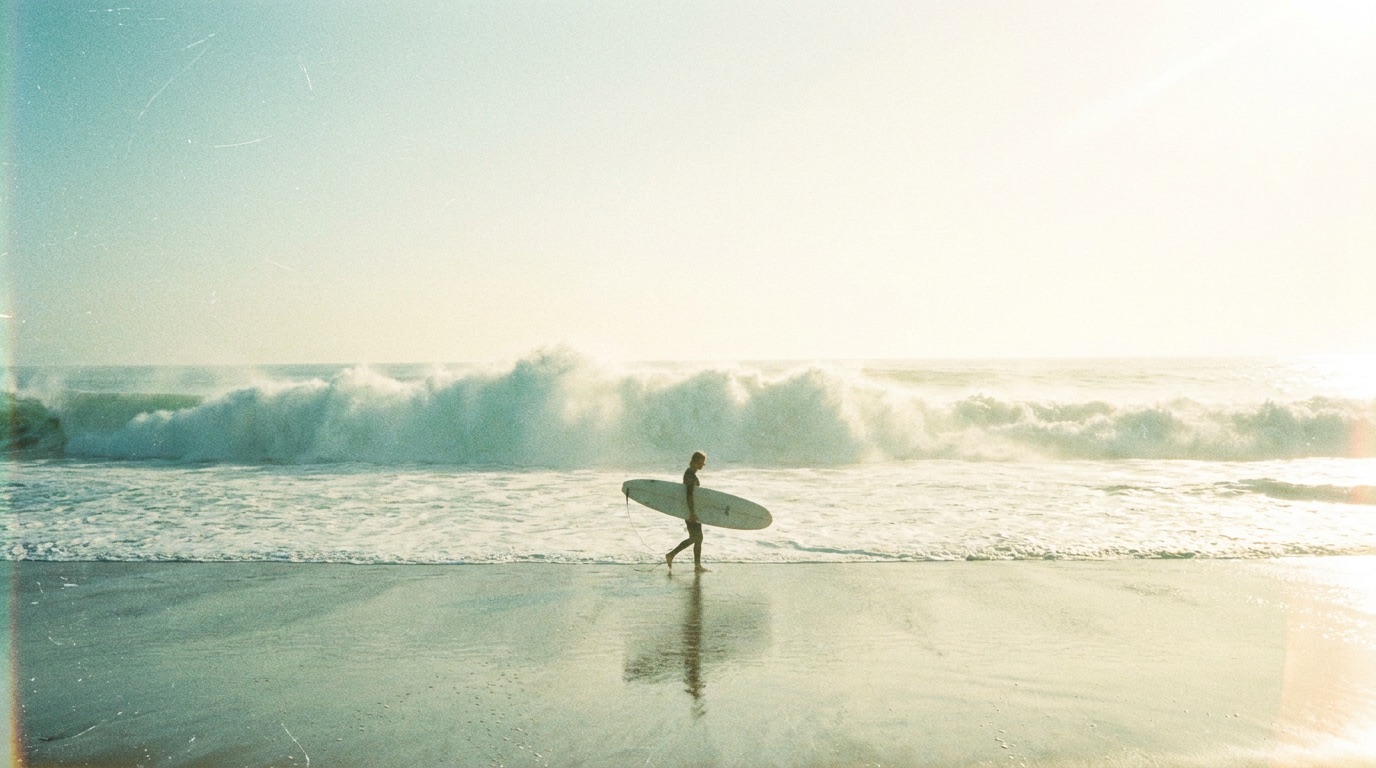
Ninth Wave looks like a screen-printed surf poster that learned to scroll — but it is one HTML file, one stylesheet and one script. Two ideas carry it: a product shelf that drifts sideways as the page scrolls (and lets you grab it), and a rotating rubber-stamp badge drawn entirely in SVG.
The idea
Surf brands usually sell the wave. Ninth Wave sells the waiting — the eight
disappointments before the good one — so the site had to feel like the noticeboard of a
cold-water surf shop: sun-bleached paper, a rubber stamp, a surf report written by someone
salty, and a shelf of heavy garments you browse sideways. The palette is beach-at-noon
(pale sand, washed denim, faded coral), deliberately opposite to the deep-blue ocean sites
everyone else ships. Every motion uses one loose, oceanic ease —
cubic-bezier(.24,1.12,.36,1) — a slow settle with a slight overshoot, like water
finding its level.
The stack
- Plain HTML/CSS/JS. No framework, no build step. The page is a poster; a bundler would weigh more than the content.
- GSAP 3.12 + ScrollTrigger (CDN, deferred) for exactly two jobs: the pinned
scroll-drift shelf and the watermark/poster parallax. Reveals, counters, the swell meter and
the countdown are vanilla
IntersectionObserver+requestAnimationFrame. - Bebas Neue / Karla / Space Mono — a tall condensed display face for badge energy, a warm grotesque for body, and a mono for sizes, temperatures and surf data.
- Zero image assets beyond one photo. All six products are flat inline SVG
garments; the grain is an SVG
feTurbulencedata-URI; the badge is hand-authored SVG.
Signature technique #1 — the scroll-drift shelf
The product shelf is a horizontal track inside a pinned section. ScrollTrigger pins the shelf
when its center hits the viewport center, then scrubs the track's x across exactly
its own overflow — so page scroll becomes sideways drift, with a 1.1s scrub lag that
makes the cards feel like they're floating on chop rather than bolted to the scrollbar:
const overflow = () => track.scrollWidth - innerWidth;

gsap.to(track, {
  x: () => -overflow(),
  ease: 'none',
  scrollTrigger: {
    trigger: shelf,
    start: 'center center',
    end: () => '+=' + overflow(),   // 1px of scroll = 1px of drift
    pin: true,
    scrub: 1.1,                     // the loose, oceanic lag
    invalidateOnRefresh: true
  }
});
The part most implementations get wrong is drag. Instead of a second animation system fighting the scrub, dragging the shelf simply maps pointer delta onto page scroll — the scrub stays the single source of truth, so mouse wheel, keyboard, scrollbar and grab all agree:
track.addEventListener('pointermove', (e) => {
  if (!dragging) return;
  window.scrollBy(0, -(e.clientX - lastX));  // drag left → scroll down → drift left
  lastX = e.clientX;
});
On screens under 861px — and for anyone with prefers-reduced-motion — the same
markup falls back to an honest overflow-x: auto row with scroll-snap. GSAP's
matchMedia() adds and removes the whole behavior, cleanup function included.
Signature technique #2 — the rotating stamp badge
The badge is one SVG: a circle of Bebas Neue set on a circular textPath, a dashed
inner ring, and a hand-drawn two-stroke wave in the middle. Only the text ring rotates — the
wave stays level, like a real stamp pressed slightly off-true:
<defs>
  <path id="badge-arc" d="M100,100 m-72,0
    a72,72 0 1,1 144,0  a72,72 0 1,1 -144,0"/>
</defs>
<g class="badge-ring">
  <text><textPath href="#badge-arc">
    NINTH WAVE · EST. 2019 · COLD WATER · NO HEROICS ·
  </textPath></text>
</g>
.badge-ring{
transform-box: fill-box; /* rotate about the ring itself */
transform-origin: center;
animation: badge-spin 36s linear infinite;
}
@media (prefers-reduced-motion: reduce){
.badge-ring{ animation: none } /* the stamp just sits there. stamps do that */
}Because the rotation is pure CSS it costs nothing, works with JavaScript disabled, and switches off cleanly under reduced motion.
Details that matter
- The "faded poster" is math, not a second image. The hero photo gets
brightness(1.06) contrast(.94) saturate(.82) sepia(.1)— overexposed a touch further than the file itself, on foam-colored paper, rotated −1.1°. - The swell meter is a living sine. Two SVG paths (fill + line) rebuilt at ~25fps from two superposed sines; under reduced motion the static path shipped in the HTML never gets replaced.
- Grain without a canvas. A fixed div with an SVG
feTurbulencedata-URI,mix-blend-mode: multiplyat low opacity — warm paper, one HTTP request saved, zero per-frame cost. - Honest fallbacks everywhere. No JS → the shelf is a scrollable row, the
countdown shows the drop date as text, counters show their targets… the
.jsclass gates every enhancement. - Contrast did the shopping. Washed slate on pale sand is ~10:1; coral and
denim exist in three graded steps each so small text always uses the AA-passing step
(
--coral-text,--denim-deep) while decoration keeps the faded ones.
Ship it on GitHub Pages
Every path is relative and there is no build, so deploying is three commands:
gh repo create ninth-wave-surf --public --source . --push
gh api --method POST /repos/USER/ninth-wave-surf/pages \
  -f 'source[branch]=main' -f 'source[path]=/'
# live at https://USER.github.io/ninth-wave-surf/ in ~1 min
A .nojekyll file keeps Pages from touching the folder structure. That's the whole
deploy. Wax not included.
Ninth Wave is a design-showcase concept — the brand, products, prices and surf report are fiction, and the signup form has no backend. See the repository README for the full demo-vs-real map.
← Back to Ninth Wave